editorials·AI-REDIGERAD
Today's Editorials: AI's Footprint, Georgia's Slide, and Sports Curses
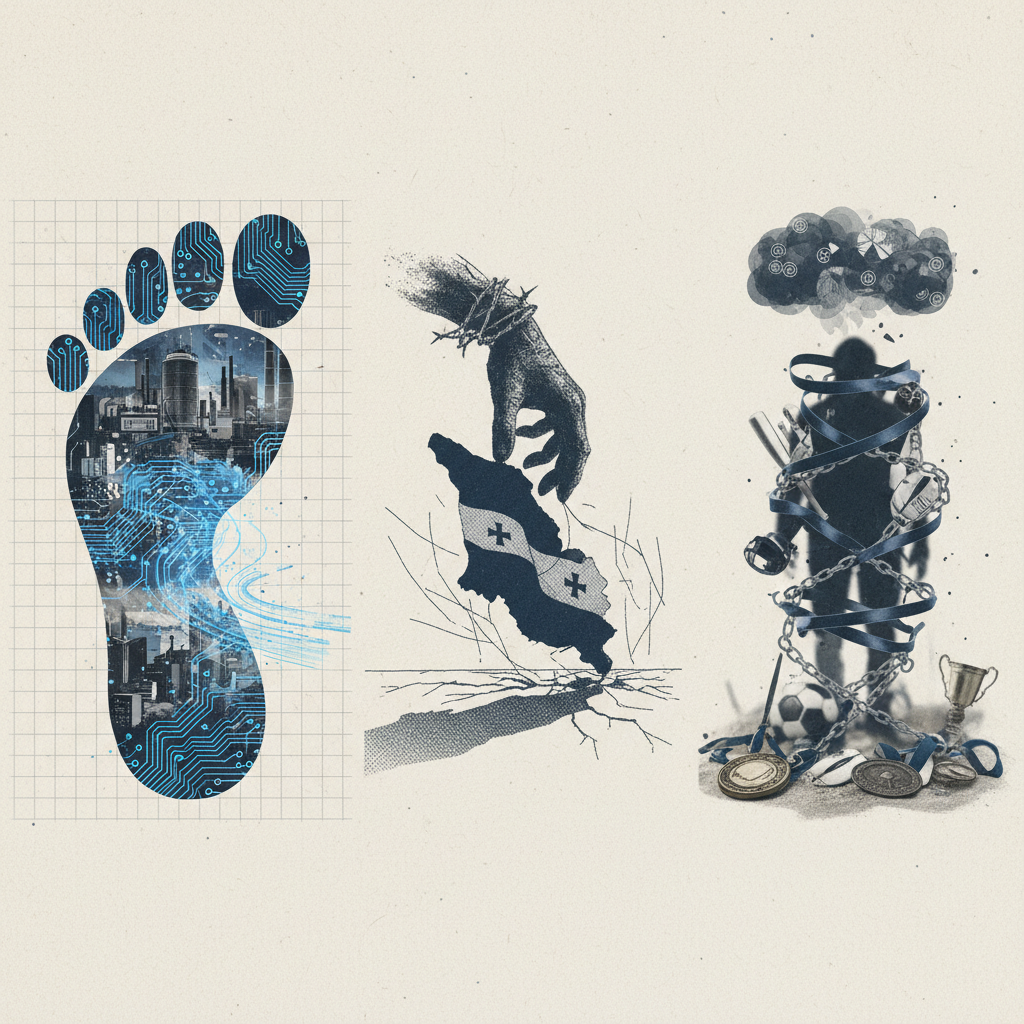
Today's global editorials focus on the societal impact of artificial intelligence, the worrying authoritarian turn in Georgia, and the psychological effects of sports superstitions.
10 augusti 2026 — synthesising 7 editorials from 3 editorial boards.
The Expanding Footprint of AI Infrastructure
Mother Jones highlights the emergence of "anti-AI populism" as a powerful, bipartisan force in American politics, with candidates gaining traction by opposing massive data center constructions. This sentiment is driven by concerns over environmental protection, corporate accountability, and the strain on local utility grids. Similarly, The Guardian argues that the rapid growth of AI infrastructure in the UK, particularly in areas like Slough, is creating a critical choice between supporting big tech's AI ambitions and prioritizing essential resources like water and housing for local communities. Both editorials underscore the growing public anxiety regarding energy costs, land use, and the broader environmental and social costs associated with the expansion of AI technology.
AI in Healthcare: Promise and Peril
Reason presents research suggesting that AI is beginning to outperform human doctors in medical diagnostics, citing studies where models like OpenAI's o1 significantly surpassed physicians in identifying correct diagnoses. This progress, however, is being threatened by restrictive state legislation in the US, with laws aiming to limit AI's role in mental health and professional care. The publication contends that these regulatory barriers could prevent patients from benefiting from the superior accuracy and early detection capabilities offered by AI-assisted medicine, even as human oversight remains crucial.
Georgia's Slide Towards Authoritarianism
Reason details the concerning political transformation in Georgia, which is reportedly moving from a capitalist utopia towards an authoritarian state. The editorial focuses on the persecution of libertarian figures like Zurab Japaridze and highlights how the ruling Georgian Dream party is allegedly using Russian-aligned legislation to dismantle NGOs, media outlets, and civil society. The piece argues that despite past economic liberalization, Georgia's democratic institutions are being sacrificed to align with Russian interests, threatening its status as a post-Soviet success story amidst alleged election fraud and the crackdown on opposition.
Government Incompetence and Overreach
Reason also highlights various instances of government inefficiency and overreach globally. The publication critiques incidents ranging from a Florida man jailed over a license plate frame to an Australian couple fined for violations committed by car thieves. It further points out the technical failures resulting from Russian internet censorship, which inadvertently crippled the nation's financial infrastructure, and instances of journalist intimidation. These examples are used to argue that state institutions often prioritize rigid enforcement and political protection over public safety and common sense.
The Immortal Jellyfish and Human Fascination
Mother Jones explores the unique biological immortality of the Turritopsis dohrnii jellyfish, which can revert to its juvenile polyp stage to reset its life cycle. This process of cellular transdifferentiation allows the tiny invertebrate to bypass natural death indefinitely under controlled conditions. The editorial reflects on the juxtaposition between humanity's long-held desire for eternal life and the effortless, recurring reincarnation demonstrated by these millimeter-sized marine creatures, while noting that they still face external threats in their natural habitats.
The Psychology of Sports Curses
The Guardian examines the psychological impact of sports curses, suggesting that while they are often dismissed as superstition, they can exert a tangible influence on players and teams. The author argues that these narratives can foster self-doubt and dread, potentially leading to self-fulfilling prophecies of failure. The editorial highlights how collective belief in a curse can affect performance in sports culture, and suggests that overcoming these
---
All sources cited today
- Mother Jones (US) — Anti-AI Populism is Reshaping American Politics
- Reason (US) — In Post-Soviet Georgia, a Fledgling Libertarian Movement Faces an Increasingly Authoritarian State
- Mother Jones (US) — Good Luck Trying to Kill This Jellyfish
- The Guardian (GB) — As AI guzzles water and energy, we are already facing a choice: datacentres or homes? | John Harris
- Reason (US) — AI Is Already Beating Human Doctors in Medical Tests
- Reason (US) — Brickbats: August/September 2026
- The Guardian (GB) — Ever thought your football team might be under a curse like Ted Lasso’s? Here’s how to lift it | Helen Pilcher
Detta vet vi
- AI'AI's societal impact'
Påståenden & källor
- M
Mother Jones: Anti-AI Populism is Reshaping American Politics
- R
Reason: In Post-Soviet Georgia, a Fledgling Libertarian Movement Faces an Increasingly Authoritarian State
- M
Mother Jones: Good Luck Trying to Kill This Jellyfish
- T
The Guardian: As AI guzzles water and energy, we are already facing a choice: datacentres or homes? | John Harris
- R
Reason: AI Is Already Beating Human Doctors in Medical Tests
- R
Reason: Brickbats: August/September 2026
- T
The Guardian: Ever thought your football team might be under a curse like Ted Lasso’s? Here’s how to lift it | Helen Pilcher