rankings·AI-REDIGERAD
Global Nuclear Arsenals: Ranking the World's Nuclear Weapons States
A detailed look at the world's nuclear stockpiles, from the legacy arsenals of the Cold War to the emerging powers in Asia and the Middle East.
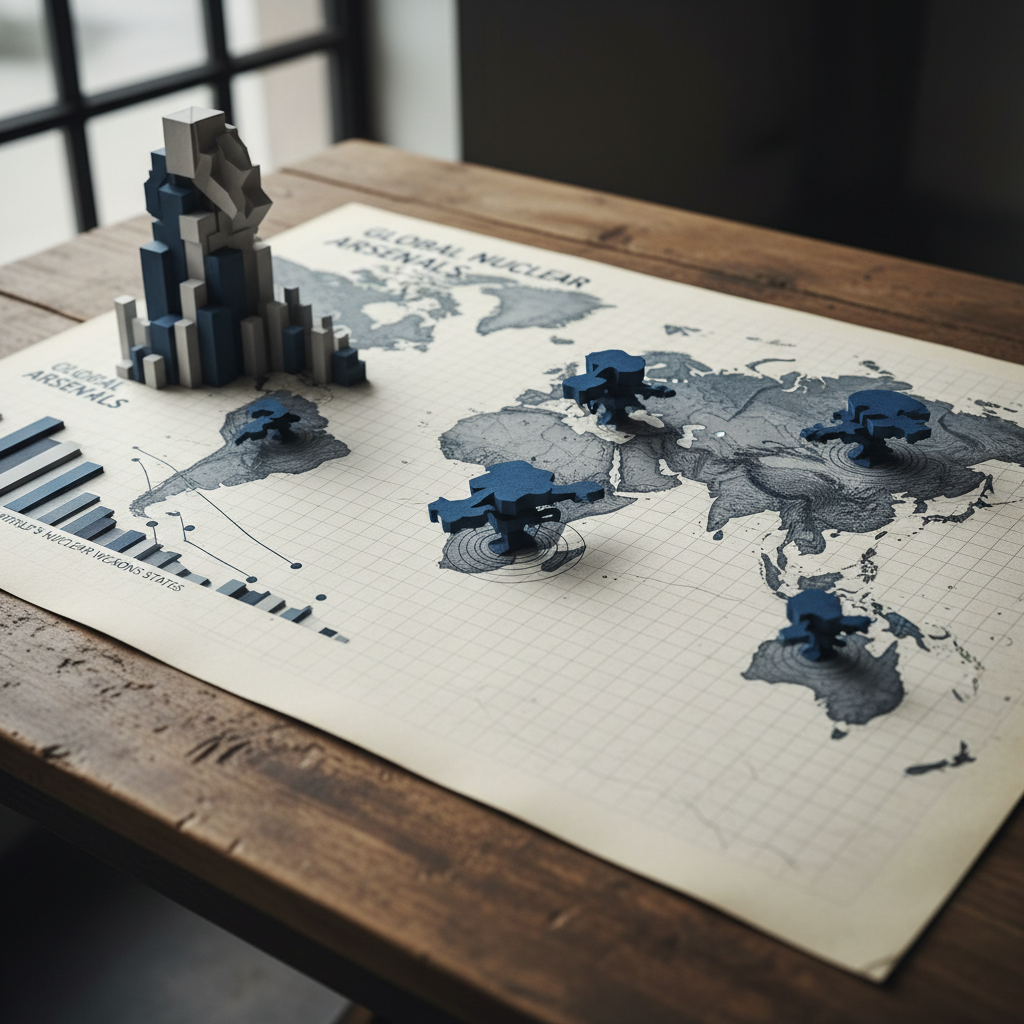
While the Cold War era of nuclear expansion has long passed, the modern geopolitical landscape is defined by the maintenance and modernization of these vast arsenals. According to data sourced from Wikipedia, the global distribution of nuclear warheads remains heavily concentrated within the borders of the two original superpowers, yet the proliferation across Asia and the Middle East continues to shape international diplomacy.
The Russian Federation and the United States occupy the top of the list by a significant margin, holding 4,400 and 3,700 warheads respectively. These figures represent the legacy of decades of bilateral competition and current strategic deterrence policies. Despite various disarmament treaties over the years, these two nations alone account for the vast majority of the world's nuclear inventory, underscoring their unique responsibility in global security frameworks.
Further down the ranking, China holds a notable position with 620 warheads. While its stockpile is smaller than those of Russia or the US, China’s steady modernization has become a focal point for Western defense analysts. Conversely, the figures for Israel (90) and North Korea (60) highlight the tactical nature of nuclear possession in volatile regions. These smaller stockpiles are often viewed not as tools for global dominance, but as ultimate security guarantees against regional adversaries.
The data illustrates a clear divide between the "P5" (the permanent members of the UN Security Council) and newer nuclear states like India (190) and Pakistan (170). For these nations, nuclear parity is a cornerstone of regional stability, serving as a deterrent in long-standing territorial disputes. As international agreements face increasing scrutiny, these numbers remain the most critical metrics for understanding the risks and realities of 21st-century warfare.
Why this is timely
Recent political tension and criticism regarding international nuclear agreements, such as those involving Iran, have renewed global focus on how nuclear stockpiles are managed and monitored. As diplomatic frameworks are tested, understanding the current distribution of these weapons is essential for assessing regional and global stability.
Detta vet vi
- Russia and the United States continue to hold the vast majority of the world's nuclear warheads.
- China ranks as the third-largest nuclear power with an estimated 620 warheads.
- Regional stability in South Asia is defined by the nuclear parity between India and Pakistan.
- Smaller stockpiles in North Korea and Israel serve as critical strategic deterrents in their respective regions.
Påståenden & källor
- W
Countries by nuclear weapons — full ranked list